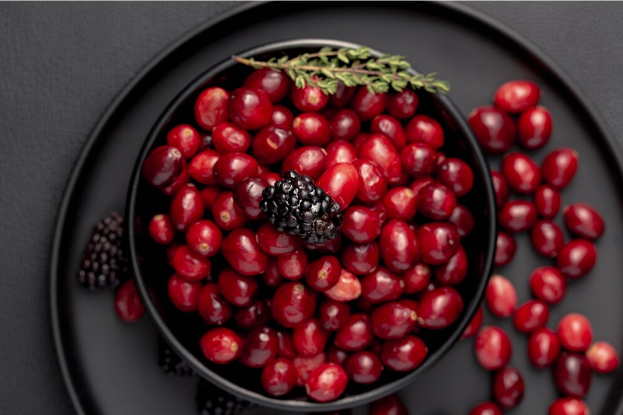
Nutritional Benefits Of Cranberries
It is known that American Indians used cranberries to make poultices, a soft, moist adhesive mass spread on a cloth to heal wounds. In addition, they enjoyed cooked cranberries sweetened with maple syrup or honey. When the colonists arrived, they also developed a taste for sweetened versions of these tart-flavored red berries.
By the beginning of the 18th century, the colonists exported cranberries to England. But, the history of cranberry cultivation changed forever in 1840 when a Massachusetts man observed that cranberries grew abundantly when the winds and tides filled his bog with sand. Bogs became the ideal medium for cranberry growth. It did not take long for cranberry cultivation to spread across the United States, especially in Wisconsin, Massachusetts, New Jersey, Oregon, and Washington. Even today, these states, led by New Jersey, are the largest producers worldwide of cranberries in bulk.
What Makes A Cranberry Healthy?
Cranberries contain excellent amounts of vitamin C and a very good dietary fiber. They have good levels of manganese and vitamin K. Though probably best known for preventing and treating urinary tract infections, cranberries are thought to be useful for several other medical problems. Research has recently been done on their use in treating cardiovascular disease and ulcers. There has been a good deal of research on cranberries. It is time to review some of what the researchers have learned.
Urinary Tract Infections And Cranberries

In a 2007 study published in Phytomedicine, researchers sought to determine whether cranberry extract treatment could help 12 women aged 25 to 70 with a history of at least 6 urinary tract infections in the preceding year. For 12 weeks, the women took one 200-mg capsule of a concentrated cranberry extract standardized to 30 per cent phenolics twice daily. During the study, none of the women had a urinary tract infection. Two years later, 8 of the 12 women who continued taking cranberries remained free of urinary infections. The researchers noted that “A cranberry preparation with a high phenolic content may completely prevent a UTI [urinary tract infections] in women who are subject to recurrent infections.”
In a 2009 study published in the Journal of Antimicrobial Chemotherapy, Scottish researchers compared the effectiveness of cranberry extract with a low dose of the antibiotic trimethoprim for preventing recurrent urinary infections in older women. The subjects were 137 women who had 2 or more antibiotic-treated urinary tract infections in the previous year. For six months, the women took either 500 mg of cranberry extract or 100 mg of trimethoprim.
While more women taking cranberry extract developed urinary tract infections, the time to infection was about the same in the two groups: 84.5 days for the cranberry extract group and 91 days for the antibiotic group. But while cranberry extract had no side effects, people taking antibiotics for extended periods may experience side effects such as nausea, stomach upset, vomiting, sensitivity to sunlight, and/or resistance to the medication. Also, see “Using Dried Cranberries to Prevent A Urinary Tract Infection.”
Nutritional Benefits Of Cranberries Prevent These Infections?
Previously, it was thought that cranberry acidity inhibited bacterial growth. However, in a laboratory study published in 2009 in the Journal of Medicinal Food, researchers from Worcester Polytechnic Institute in Worcester, Massachusetts, determined that it was not the acidity of the cranberries but, rather, chemicals in cranberries. About 85 percent of all urinary tract infections are caused by the adhesion of E. Coli bacteria to the cells lining the urinary tract.
The researchers found that cranberry proanthocyanidins alter the surface properties of bacteria. Therefore, they are unable to adhere to the epithelial cells of the urinary tract. Moreover, the effect may be reversed – “because bacteria that were regrown in cranberry-free medium regained their ability to attach to uroepithelial cells and their adhesion forces reverted to the values observed in the control condition.” Thus, when people stop consuming cranberries in food or supplements, urinary tract infections are likely to return.
Cardiovascular Health And The Nutritional Benefits Of Cranberries

In a 2006 study published in the British Journal of Nutrition, researchers from Quebec investigated the effect of increasing daily doses of a low-calorie cranberry juice cocktail on plasma lipid levels in 30 abdominally obese men with a mean age of 51. During three 4-week periods, the men drank 125 ml/day, 250 ml/day, or 500 ml/day. No changes were noted in total and LDL (bad) cholesterol levels. While the men’s HDL (good) cholesterol levels did rise. The researchers concluded that the nutritional benefits of cranberries and similar antioxidants, such as flavonoids, may well protect cardiac health.
In a Finnish study published in 2008 in The American Journal of Clinical Nutrition, researchers asked 72 middle-aged “unmedicated” subjects with cardiovascular risk factors to consume moderate amounts of berry products (such as cranberries) or a control product for 8 weeks. Subjects with high baseline blood pressure showed a significant decrease in systolic blood pressure. Furthermore, the levels of cholesterol remained the same, and the concentrations of serum HDL cholesterol increased significantly. More in the berry-eating group than in the control group. The researchers noted that regular berry intake “may play a role in the prevention of cardiovascular disease.”
ULCER TREATMENT AND PREVENTION OF STOMACH CANCER
In a study published in 2007 in Molecular Nutrition And Food Research, Israeli researchers treated 177 patients with the Helicobacter Pylori bacteria. Research shows that this causes ulcers and has an association with stomach cancer. The standard treatment is a one week triple therapy: omeprazole, amoxicillin, and clarithromycin (O AC ). During this therapy, 89 patients received cranberry juice twice daily, and 88 received a placebo. At the end of the week, the patients stopped taking the OAC therapy. Then, they continued with cranberry juice or a placebo for another 2 weeks. Seven hundred twelve patients treated for pylori only with OAC served as an additional control group.
Initially, there did not appear to be a significant difference between the cranberry and placebo groups. Yet, when analyzing the data by gender, an important difference emerged. Among females, the eradication rate was significantly higher among those who drank cranberry juice. No such differences were found in males. The researchers concluded that “the addition of cranberry to triple therapy improves the rate of H. pylori eradication in females.”
Gum Health
In a 2007 study in the Journal of Periodontal Research, researchers from Quebec learned that cranberry extract inhibits the action of enzymes. These are associated with periodontal (gum) disease. The researchers noted that their results “suggest that cranberry compounds offer promising perspectives for the development of novel host-modulating strategies for an adjunctive treatment of periodontitis.” (Periodontitis is a serious gum infection that kills soft tissue and bones that support teeth.)
Cranberries For Patients With Type 2 Diabetes
In a randomized, placebo-controlled, double-blind 12-week study published in 2008 in Diabetic Medicine, researchers enrolled 16 men and 14 women, with a mean age of about 65, who were taking oral glucose-lowering medication. The researchers examined the effects of cranberry supplements on lipid profiles in patients. They found that people taking cranberry supplements had lower total and LDL cholesterol levels. They also had improvements in their HDL (good) cholesterol ratios. At the same time, there was a “neutral effect on glycaemic control”. Should people eat cranberries, drink cranberry juice, and/or take supplements? For most people, they are a helpful addition to the diet. Be aware that cranberry products often contain fairly high amounts of sugar. It is best to select products with lower amounts of added sugar or none at all.
Research by:
Healthy Foods: Fact Versus Fiction
By Myrna Chandler Goldstein, Mark Allan Goldstein